How Weldmesh Impacts Long-Term Industrial Project Success
Introduction
Weldmesh for industrial projects plays a critical role from the early stages of construction to long-term operational success. Every industrial or infrastructure project begins at the ground level. The foundation and basement stage relies on reinforcement mesh to give the structure its strength before civil work can move forward. Once that stage is done, a different set of materials takes over, covering partitions, fencing, storage, and space-saving solutions through the facility’s working life.
Weldmesh has become one of the most trusted materials in this second stage, valued for its durability without adding unnecessary complexity. This article looks at how material choices shape a project from the ground up, and where weldmesh fits into that journey.
Why Weldmesh for Industrial Projects Is Widely Preferred
Selecting the right industrial materials is not just a procurement decision. It directly influences structural safety, project timelines, and long-term costs. Poor choices at the planning stage lead to early wear and higher expenses down the line.
A few factors guide sound material selection:
- Load-bearing capacity and strength required
- Resistance to corrosion, moisture, and temperature swings
- Ease of installation and future modification
- Compliance with safety and industry standards
- Total lifecycle cost, not just purchase price
Weldmesh for Industrial Projects: A Closer Look
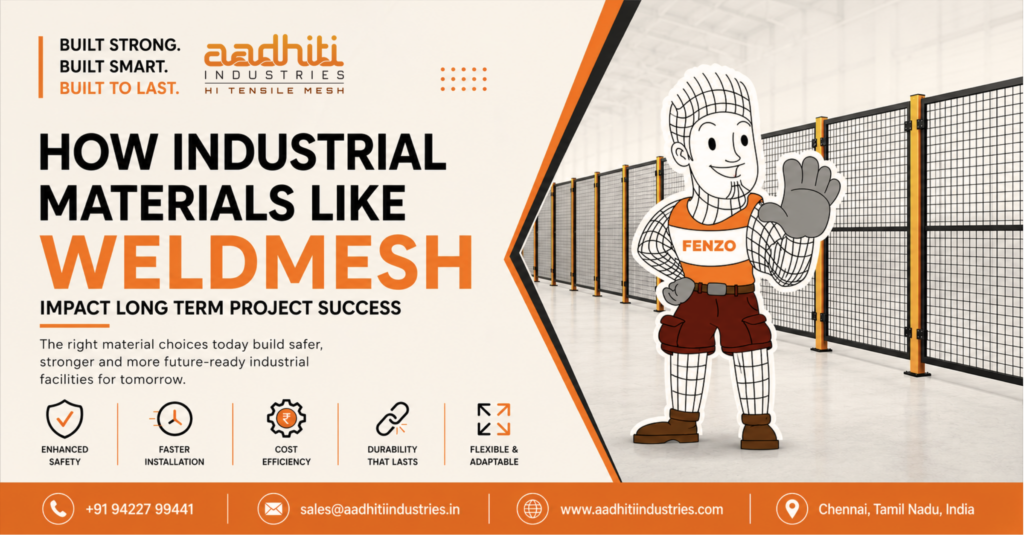
Weldmesh strikes a practical balance between strength, flexibility, and cost efficiency. Unlike solid partitions, it allows airflow, visibility, and quick assembly while holding up under demanding conditions.
Key advantages include:
- Faster installation than permanent brick or concrete structures, reducing overall project timelines
- Lower long-term maintenance requirements due to corrosion-resistant coatings and welded construction
- A practical fit whenever a quick partition is needed, or when mesh works as an alternative to a full compound wall
- Useful for segregating two spaces while keeping visibility intact, even where room for a conventional wall is limited
Common Applications of Weldmesh for Industrial Projects
Weldmesh is rarely limited to one function on a site. Its adaptability is one of the main reasons it appears in so many parts of an industrial facility, and it is not limited to warehouses alone.
Typical applications include:
- Warehouse partitions for dividing storage, staging, and restricted zones
- Machine guarding to enclose equipment and protect operators
- Cable trays for organized, ventilated cable routing
- Decking mesh for pallet racking systems that need load support with airflow
- Perimeter and security fencing around facilities and high-value zones
- Collapsible container for storage and logistics
Because the same base material can serve so many purposes, procurement and maintenance become simpler for facility teams managing multiple areas.
Best Industrial Materials for Construction Projects
While weldmesh plays an important role, most infrastructure and industrial projects rely on a combination of materials working together. Identifying the best industrial materials for construction usually comes down to matching material properties with the specific demands of the project.
Materials that consistently perform well include:
- Structural steel for its strength-to-weight ratio and long service life
- Galvanized steel for resistance to rust and environmental wear
- Welded wire mesh panels for partitioning and safety enclosures
- Powder-coated finishes to extend component life
- Decking mesh for applications with heavy load-bearing requirements
- Collapsible containers for industrial storage where space efficiency matters
Combining these materials based on the environment and load requirements produces far more consistent results than relying on a single material type throughout a project.
Industrial Materials for Infrastructure Development
As infrastructure across India expands, from logistics parks to manufacturing corridors, demand for dependable industrial materials grows with it. These projects need materials that withstand continuous use and years of exposure without major replacement.
Infrastructure projects benefit from materials that offer:
- Long service life with minimal maintenance
- Proven performance under heavy daily use
- Modular design for future expansion
- Certified compliance with safety standards
Welded wire mesh systems are increasingly specified here because they meet these needs while staying cost-effective over the full project lifecycle.
Weldmesh Compared to Traditional Construction Materials
Businesses often weigh welded wire mesh against brick walls, drywall, or solid metal sheeting before deciding on a partition or enclosure system. Each option comes with trade-offs worth understanding.
- Installation time: Weldmesh panels are prefabricated and assembled in days, while brick or drywall construction can take weeks and involve permits
- Flexibility: Weldmesh can be relocated or reconfigured, whereas permanent walls must be demolished and rebuilt
- Visibility and airflow: Open mesh design supports ventilation and supervision, which solid partitions block
- Long-term cost: Lower labour and maintenance costs over time often offset any difference in upfront material price
For facilities expecting to scale, relocate, or reorganize, this flexibility often outweighs the marginal cost difference against permanent construction.
What Makes High-Quality Construction Materials Different
Not everything marketed as industrial grade performs consistently. Quality is best judged by measurable factors, not marketing claims.
When evaluating a supplier, check for:
- Consistent raw material sourcing
- Proper finishing suited to the environment
- Adherence to recognized standards
- A track record on comparable projects
- Clear warranty and after-sales support
Common Mistakes in Industrial Material Selection
- Choosing the lowest quoted price without checking finish quality or certifications
- Overlooking environmental factors like humidity or dust exposure at the site
- Failing to plan for future expansion, leading to mismatched panels or finishes later
- Not confirming after-sales support before the contract is signed
- Skipping a site-specific evaluation and relying on generic industry averages
- Ignoring long-term maintenance costs in favour of upfront savings
Conclusion
Material selection made early is what drives long-term project success. Welded wire mesh has proven its value across warehouses, factories, and infrastructure sites for its strength, flexibility, and speed of installation.
Choosing quality materials upfront and working with a supplier who understands site-specific requirements cuts down on repairs, downtime, and replacement costs over the life of the project.
Get in Touch
Every site has different load, space, and durability needs. Talk to Aadhiti Industries at sales@aadhitiindustries.in or +91 94227 99441 to engineer the right welded wire mesh solution for yours.